
The cabinet's story · 01
Packard Bell RPC-17A
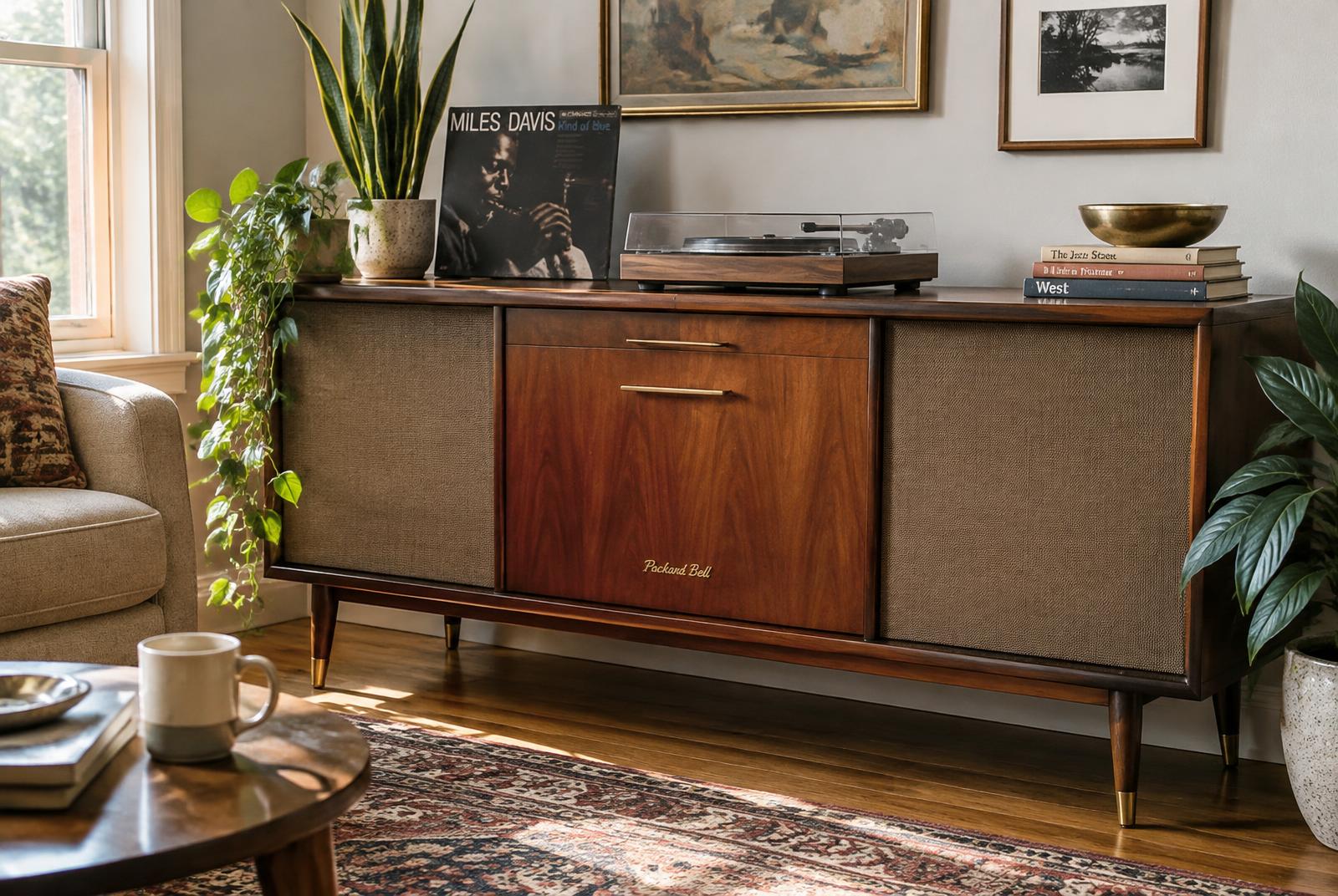
A compact piece of mid-century audio furniture, reborn as 序 Jo PB-17A.
Los Angeles roots
A home for music
Packard Bell's radio-making roots reach back to Los Angeles in 1933, when Herbert Bell and Leon Packard founded the company. Its vintage consoles belong to an era when the record player, radio and speakers shared a place within a single piece of furniture.
This RPC-17A carries that idea in compact proportions. At 37 inches wide, its cabinet gives the first Jo restoration an intimate scale. The original model stays in its identity: PB remembers Packard Bell, and 17A remembers the cabinet it was born from.
Sound as furniture
Packard Bell grew as a West Coast electronics maker. Its radios even carried regional station names on their tuning dials. By the console era, listening was woven into the living room: cabinetry, controls and speakers formed a single presence.
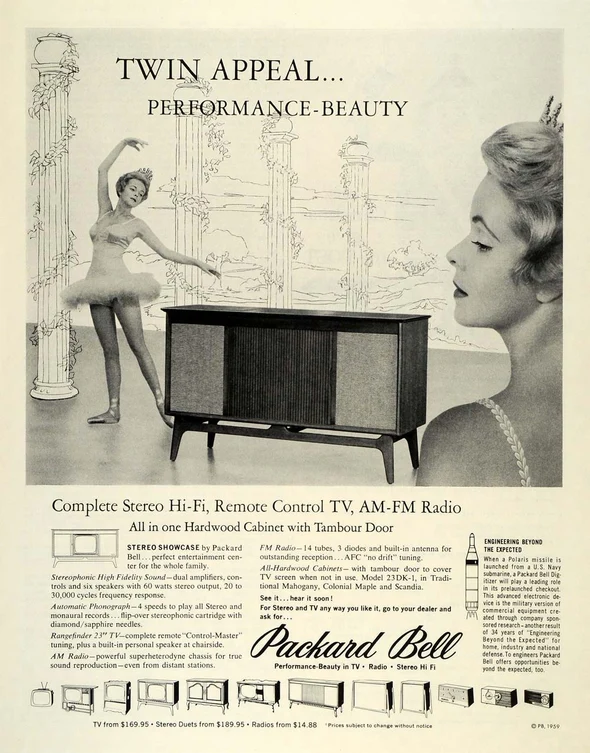
The period advertisement below pairs a stereo cabinet with a television in matching furniture. Its twin theme makes the design intention visible: electronics that belonged together in the home. That relationship between sound and furniture is the starting point for this restoration.

A page from 1959
Stereo Showcase
This full-page Packard Bell advertisement from 1959 presents the Stereo Showcase, model 23DK-1: a hardwood cabinet with a tambour door holding stereophonic high fidelity with dual amplifiers and six speakers, AM and FM radio, a remote-control television and an automatic four-speed phonograph. The same page carries the company's "Engineering Beyond the Expected" line beside its Polaris missile digitizer, a reminder that the same engineering served home audio and national defense.
The advertised cabinet is a 23DK-1, not this RPC-17A. What it shows is the standard the era was sold on: real stereo output, a record player built into the furniture and controls a household could trust. That is the standard this restoration keeps, with today's electronics inside.
The cabinet stays at the center
The deep walnut finish, the record player and the furniture's presence set the character of this build. Modern electronics and a new speaker installation bring that character into daily listening. Each decision serves the console as a complete instrument.
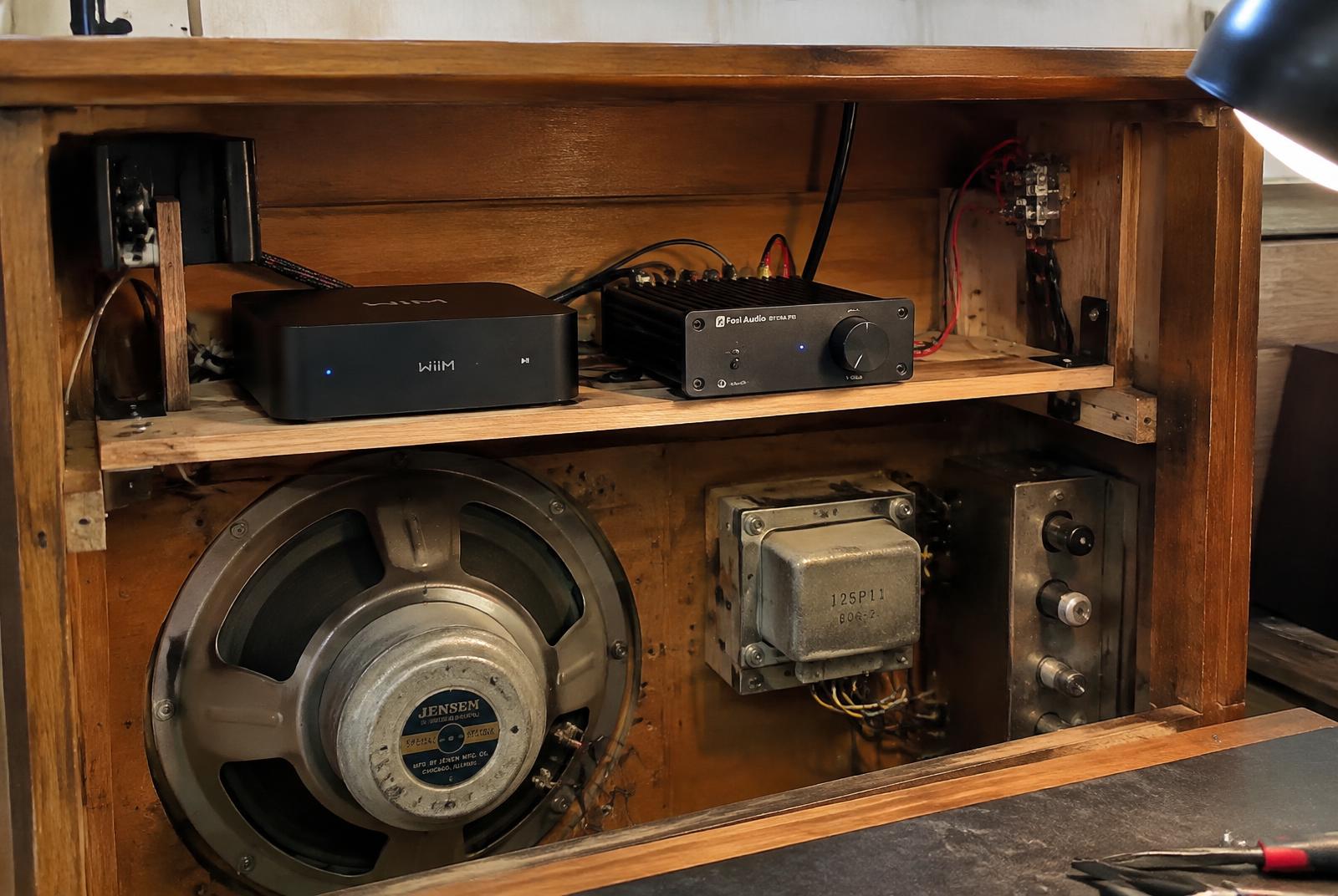
One integrated listening experience
The restored cabinet now brings a German Dual 1019 turntable, a dedicated phono preamp, AIYIMA A07 Pro amplification and NHT SuperOne speakers together. The included WiiM Pro Plus adds remote control, AirPlay 2, Chromecast, UPnP/DLNA and high-resolution playback up to 24-bit/192 kHz, independently or within a compatible multiroom system.
An optional WiiM Ultra replaces Pro Plus with an ESS DAC and touchscreen, while AirPlay remains a feature of Pro Plus. The console is subwoofer ready for optional bass expansion. Pairing, placement and tuning keep the console itself at the center of the listening experience.
Follow the restoration process →The documentary record
Labels, manuals & listening history
RPC-series service records document several different chassis and configurations. A manual for a neighboring model is useful historical context, but the original electronics in this RPC-17A must be identified from its own labels. Its precise production year, original amplifier, changer and speaker arrangement remain unconfirmed.
Packard Bell company history ↗
Regional identity, stationized radio dials and Los Angeles origins.
RadioMuseum: RPC-1 ↗
A related console record and service references, not this RPC-17A.
SAMS: RPC41A, set 810-9 ↗
A verified neighboring-model schematic listing. Paid document; applicability to RPC-17A is unconfirmed.
AudioKarma: DPA-10 amplifier discussion ↗
Collector discussion about a Packard Bell amplifier; not evidence of the original chassis in this cabinet.
Dual 1019 factory service manual ↗
Manufacturer-hosted documentation and technical drawings for the turntable installed in this restoration.
The next additions to this build record are the cabinet and chassis labels, cartridge identification, phono-preamp model and the installed SuperOne revision. These will connect the archive to the exact equipment in Jo PB-17A.